What Lens Types Are Available for Same-Day Eyeglasses?
Learn which lens types may be available for same-day eyeglasses, including single-vision, polycarbonate, high-index, bifocal, progressive, photochromic, and treated lenses, and what can affect turnaround time.
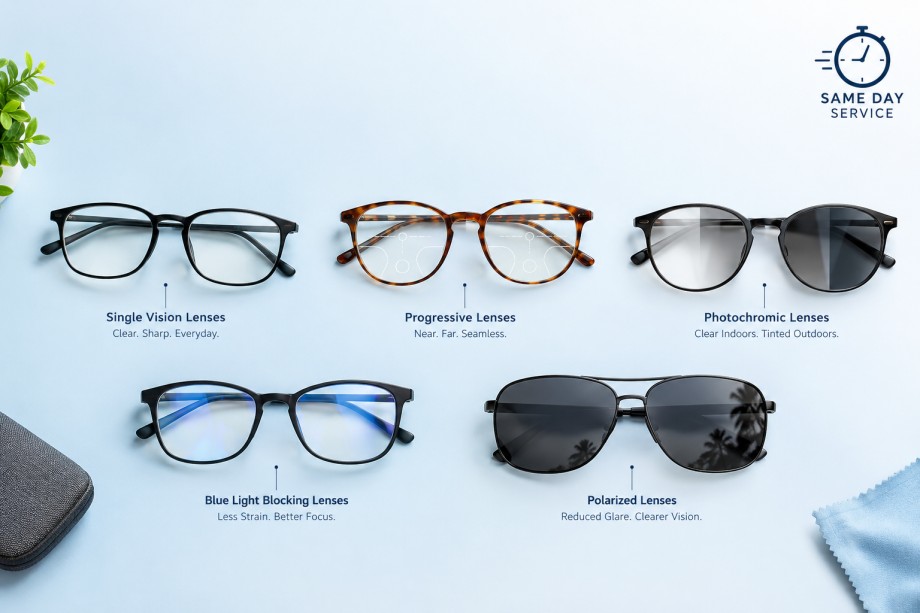
What Lens Types Are Available for Same-Day Eyeglasses?
Need a new pair of prescription glasses today? The frame is generally the simplest part to choose. The lens is where the timing gets complicated.
An optical store may have hundreds of frames ready to try, but that does not mean every prescription lens is sitting on a shelf waiting to be fitted. The lens material, prescription, design, coating, and available lab equipment all affect how quickly a pair can be completed.
For someone who needs glasses today, understanding these differences can make the ordering process much easier. If you need your prescription glasses as soon as possible, learn more about same-day eyeglasses and how the process works before choosing your lens type.
Start With the Lens Design, Not the Frame
Before choosing a frame, tell the optician what you need the glasses for.
If you only need correction for distance or reading, you may have more same-day choices. If you need one pair for distance, computer work, and reading, the lens design becomes more involved.
This is why a person replacing a basic pair of distance glasses may walk out with new glasses the same afternoon, while someone ordering a customized progressive lens may need to wait longer.
Here are the lens options you may encounter when looking for same-day glasses.
Single-Vision: The Most Straightforward Option
Single-vision lenses correct one range of vision throughout the lens.
They are commonly prescribed for people who need:
Distance correction
Near or reading correction
Correction for nearsightedness
Correction for farsightedness
Astigmatism correction
For same-day orders, these lenses are often the easiest to produce because the lens design is less complicated.
That does not guarantee a one-hour turnaround. The exact prescription still needs to be available in the required lens material, and the frame must be suitable for the lens.
If your glasses broke this morning and you need a replacement before the end of the day, a single-vision prescription is worth asking about first.
Polycarbonate: A Practical Choice for Active Wearers
Polycarbonate is a lightweight lens material known for its impact resistance.
It is frequently considered for children's eyewear, active lifestyles, and situations where durability matters. It can also be a convenient choice when an optical shop keeps polycarbonate blanks in common powers.
The important point is that polycarbonate availability varies by prescription.
A store may have the material available but not the exact power needed for your prescription. If the required lens has to be ordered, the material itself will not make the glasses same-day.
And if you need certified protective eyewear for work, don't choose a lens solely because it is polycarbonate. The finished safety eyewear needs to meet the relevant safety requirements.
High-Index Lenses: When Lens Thickness Matters
Prescription strength can change which lens material makes sense.
High-index lenses bend light more efficiently than standard plastic lenses, allowing certain stronger prescriptions to be made thinner.
They can be useful for people who are concerned about the thickness or weight of their lenses. However, high-index lenses are not always available for immediate fabrication.
This is an important distinction when you need glasses urgently.
You may have a prescription that is simple from a design standpoint, but if the required high-index lens is not available locally, the glasses may need to be ordered.
For a strong prescription, ask about the exact material and power available today, rather than simply asking whether the store offers high-index lenses.
Bifocals: A Single Lens with Two Distinct Vision Areas
Bifocals combine distance and near correction in the same lens.
Unlike single-vision lenses, they have two distinct viewing areas. The design is well established, but the optical shop still needs the correct lens and specifications for your prescription.
Some optical labs can produce certain bifocal prescriptions quickly when the required lenses are already available. Others may need additional processing or an outside laboratory.
If you need bifocals urgently, it is better to confirm availability before spending time selecting a frame.
Progressive Lenses: More Measurements, More Variables
Progressive lenses are designed to provide distance, intermediate, and near vision without a visible line across the lens.
They are also one of the lens choices where same-day service becomes more dependent on the individual order.
The progressive design has to work with the chosen frame, prescription, measurements, and lens material. Some optical stores can provide selected progressive designs quickly, while others need to order them from a laboratory.
If you are replacing a pair of progressives, bring your current glasses if possible. They can give the optician useful information about your existing setup.
And ask about the actual turnaround time before placing the order.
Clear Lenses With Anti-Reflective Treatment
Sometimes the lens itself is not the reason an order takes longer. The treatment added to it can affect the schedule.
Anti-reflective treatment reduces reflections from the lens surface and is commonly selected for everyday prescription glasses.
If the store already has the lens with the desired treatment available, it may fit into a same-day workflow. If the lenses need to be sent elsewhere for coating, the order may take longer.
Photochromic Lenses: Convenient, But Check Availability
Photochromic lenses change from relatively clear indoors to darker when exposed to suitable UV light outdoors.
They are popular with people who prefer not to carry a separate pair of prescription sunglasses.
But photochromic lenses are usually a specialized lens option rather than the default lens stocked in every optical lab.
If the required prescription and lens type are already available, same-day production may be possible. If not, the photochromic lenses may need to be ordered.
If your main priority is leaving with glasses today, ask whether a clear version can be completed immediately and whether the photochromic option would require additional time.
Blue-Light Filtering: Ask What Is Actually Available
Blue-light filtering can be incorporated into certain prescription lens options.
However, it should not be treated as a guarantee of faster or slower production. What matters for same-day service is how that particular lens is supplied by the optical shop.
Some stores may have suitable lenses readily available. Others may need to order the specific lens or treatment.
If you want this option, mention it before the lenses are cut. Changing the lens choice after production has started can create unnecessary delays.
Why Two People With the Same Prescription May Have Different Wait Times
This is something many customers don't realize.
Imagine two people have the same basic distance prescription.
Customer A chooses a frame that works with a lens the store has in stock. The store has an in-house finishing lab, and the required lens power is available.
Customer B chooses a different frame and requests a lens material that the store does not have available.
The prescriptions are identical.
The turnaround time isn't.
That is why same-day availability is not determined by prescription strength alone.
Bring your current prescription if you have it. If you are replacing an existing pair, bring those glasses too. They can help the optician understand your current lens setup and frame preferences.
It also helps to know what matters most to you:
Lowest possible lens thickness
Lightweight lenses
Impact resistance
Progressive vision
Anti-reflective treatment
Photochromic lenses
Getting the glasses as quickly as possible
You may not be able to have every option immediately, so telling the optician your priority makes the decision easier.
So, Which Lens Is Best for Same-Day Glasses?
There isn't one lens type that works for every same-day order.
Single-vision lenses are often the simplest candidates when the required prescription and material are in stock. Polycarbonate can be an option when durability is important. High-index lenses may be useful for stronger prescriptions but depend heavily on inventory. Bifocals and progressives can sometimes be completed quickly, but their availability is more dependent on the specific design and measurements. Treatments such as anti-reflective, photochromic, or blue-light filtering options also depend on what the optical shop can provide immediately.
The fastest route is usually not choosing a lens from a list.
It is matching your prescription, frame, lens material, and desired features with what the optical lab can produce that day.
If you need a new pair urgently, give the optical shop your prescription first. Once they confirm which lens options are available for immediate production, you can choose the frame and features without guessing how long the finished glasses will take.
.webp)
.webp)