My Glasses Arm Fell Off—Can It Be Repaired Without Buying New Glasses?
A glasses arm falling off does not always mean you need a new pair. Learn what causes temple and hinge damage, when a repair may be possible, why DIY glue can make things worse, and when replacing the frame is the better option.
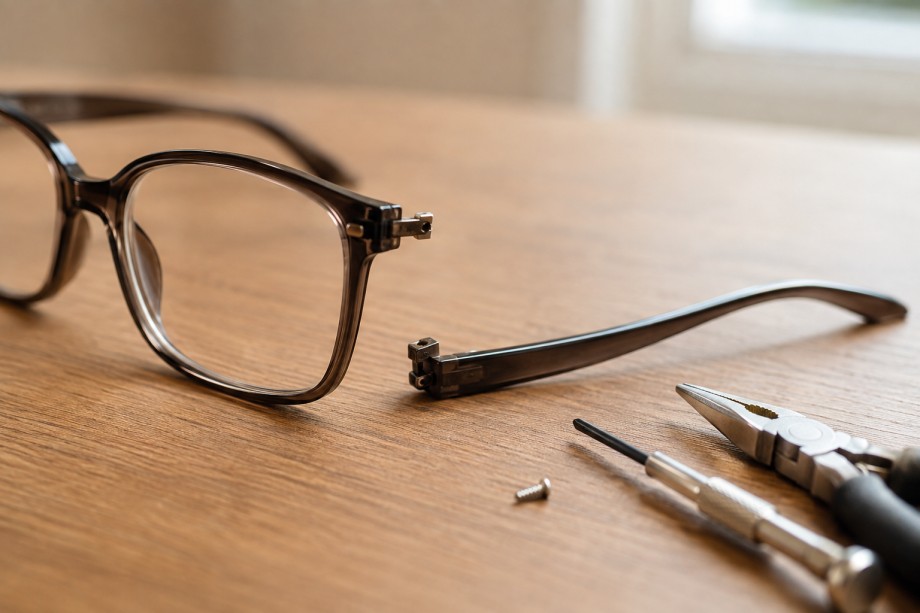
A particular kind of panic comes with a broken pair of glasses.
You need your glasses to see, but now one side is sitting on the table instead of behind your ear. The frame may look ruined at first glance, especially if the arm has completely separated.
Before ordering another pair, look at what actually failed.
A glasses frame is not one solid piece. The front, temples, hinges, screws, nose pads, and lenses all serve different purposes. Damage to one component does not automatically make everything else unusable.
In some cases, the lenses can stay exactly where they are while the damaged part of the frame is repaired.
The Arm Did Not Necessarily “Break”
When someone says their glasses arm fell off, that description can cover several different situations.
The temple might have separated because a tiny fastener worked loose. The hinge could have pulled away from the frame. The arm itself might have fractured. Or the frame material around the hinge may have split.
Those differences matter.
For example, a temple that has simply separated from an otherwise undamaged hinge is a very different repair from a temple that has snapped through the middle.
So don't judge the condition of the entire pair by looking at the detached arm alone.
Turn the Glasses Over and Check the Hinge
You don't need special tools to make a basic assessment.
Place the glasses on a clean, flat surface and look at the area where the arm normally connects to the front.
Is the hinge still attached?
Is there an empty screw hole?
Does the arm still have its hinge?
Is there a visible crack in the frame?
Has any piece of metal or plastic actually broken away?
If everything around the connection looks intact except for a missing screw, you may be looking at a relatively small repair.
If the frame has split around the hinge, the technician will need to deal with the damaged frame itself.
A Tiny Screw Can Cause a Very Big Problem
The hardware used in eyeglasses is small enough to disappear almost instantly if it falls onto the floor.
That little screw, however, is responsible for keeping the temple connected to the frame.
If you still have the screw, put it somewhere safe. Don't assume it is useless simply because it came out. The eyeglass repair shop can examine it along with the hinge.
If the screw is gone, that still doesn't mean the glasses are finished. A suitable replacement may be available.
The important thing is using the right hardware rather than forcing a random screw into the opening.
When the Hinge Is the Real Culprit
Sometimes the arm falls away because the hinge has suffered the damage.
This can happen after the glasses are crushed in a pocket, sat on, dropped, or repeatedly stressed over time.
A damaged hinge can leave the temple sitting at an odd angle. You may also notice that one side no longer folds like the other.
That is not something to solve by repeatedly bending the arm.
Every attempt to force the hinge into position can put more pressure on the surrounding frame. If the material is already weakened, a small defect can become a much larger break.
What If the Frame Is Plastic?
Plastic frames require particular care around the hinge area.
If the material has cracked, the repair possibilities depend on the construction of the frame and how extensive the damage is. A surface mark is obviously different from a section that has separated completely.
Don't assume that adhesive will restore the original strength.
The hinge has to withstand movement every time you put the glasses on or take them off. A repair that merely holds the pieces together while sitting on a table may not survive normal use.
What If the Frame Is Metal?
Metal frames can sometimes be adjusted when a temple has been bent out of position.
But repeatedly bending a thin metal frame back and forth is not a good experiment. Metal can weaken after repeated deformation, and a hinge that looks slightly crooked may have damage that isn't obvious from the outside.
A repair professional can determine whether the temple needs alignment, a hinge component, or a more extensive repair.
Don't Assume Super Glue Is the Answer
The temptation is understandable.
The arm is separated. You have glue. The problem appears to have an obvious solution.
But an eyeglass hinge is supposed to move. Glue can seep into that moving area and restrict it. It can also leave residue on the frame or complicate subsequent repair work.
Worse, a glued joint may fail while you are wearing the glasses.
If the goal is to keep your existing pair functioning properly, an optical repair is a better approach than permanently gluing the pieces together at home.
What If the Arm Has Snapped Completely?
This is where the answer becomes more dependent on the frame.
If the temple has broken into two pieces, the question is no longer simply how to reconnect it to the front. The damaged section itself has to be addressed.
A replacement temple may be possible if a matching component can be obtained. Some frames have replaceable parts, while others are difficult to match once the original model is no longer available.
Even when an identical arm cannot be found, the rest of the glasses may still be useful. A repair shop can tell you whether there is a practical way to preserve the frame and lenses.
Your Lenses Are a Separate Consideration
This is an important point if you have recently paid for prescription lenses.
A damaged temple does not automatically mean damaged lenses.
If the lenses are still in good condition and your prescription has not changed, replacing the entire pair may be unnecessary. Depending on the frame damage, repairing or replacing the affected frame component may allow you to continue using those lenses.
That is why it makes sense to take the whole pair to an optical shop before ordering replacements.
When a New Pair Makes More Sense
There are situations where repairing the frame isn't the sensible choice.
If the frame has cracks in several places, both temples are badly worn, the lenses are heavily scratched, or the glasses are already due for a prescription update, replacement may offer better value.
An optical professional can assess the condition of the complete pair rather than focusing only on the fallen-off arm.
The cheapest repair is not always the best repair. What matters is whether the finished glasses will remain stable and comfortable during everyday use.
What Should You Do With the Broken Pieces?
Keep them.
That includes the detached arm, loose screw, hinge component, or any small piece that came away when the glasses broke.
Put everything in a small container or case so nothing disappears before you reach the optical shop.
Don't keep testing the damaged connection. Repeated movement can make the original damage worse and may remove useful pieces that could have helped with the repair.
So, Do You Really Need New Glasses?
Not necessarily.
A fallen-off glasses arm can be the result of something as small as lost hardware, or it can indicate serious damage to the hinge or frame. You cannot tell which situation you have simply from the fact that the arm came off.
If your lenses are still good and the rest of the frame is sound, repairing the damaged section may allow you to keep the same glasses.
If you decide that replacement makes more sense, compare different eyeglasses styles, prices, and buying options in Houston before choosing your next pair.
If the frame has suffered extensive damage, replacing it may be more practical.
The best first step is therefore not ordering a new pair. Take the glasses apart only as much as the damage already has, keep every loose piece, and have the frame evaluated by an optical repair professional.
You might discover that you don't need new glasses at all—just a repair to the part that failed.


.webp)
.webp)